| New Eden | |
|---|---|
| Type | Primary Settlement |
| Population | ~200 colonists (book-1) → ~600 (book-5) |
| Location | Southern hemisphere, near the Pison River |
| Structures | Stone, steel, glass dwellings; six central buildings; fusion reactor; colony modules |
| Landmarks | Central Roundabout, Fusion Reactor, New Eden Observatory |
| Transport | Autocabs, aerial VTOLs, space shuttles |
| Climate | Arid plains, ~26°C daytime average |
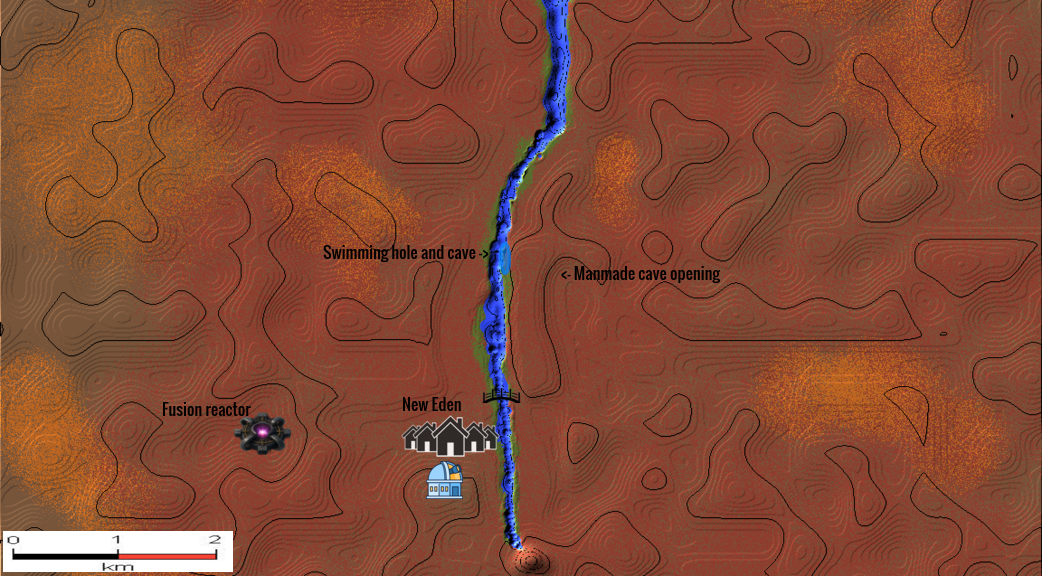
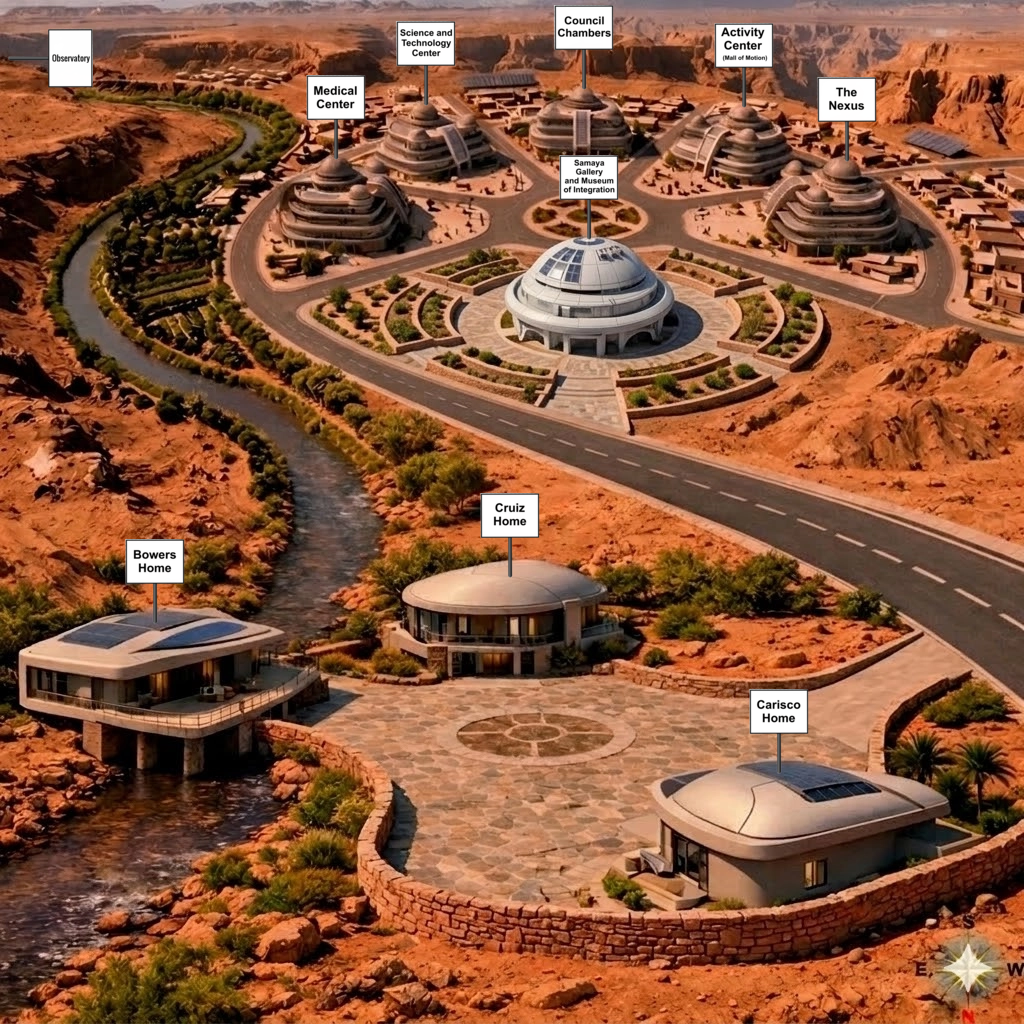
| Map | |
| See Also | The Six Central Buildings |
Contents
Overview
New Eden is the first permanent settlement established on the surface of the moon, Ares. Designed to house the initial wave of colonists after stasis, it remains the administrative and symbolic heart of the colony. Though small in population, its infrastructure supports interplanetary communication, governance, and early-stage terraforming efforts.
Layout and Structures
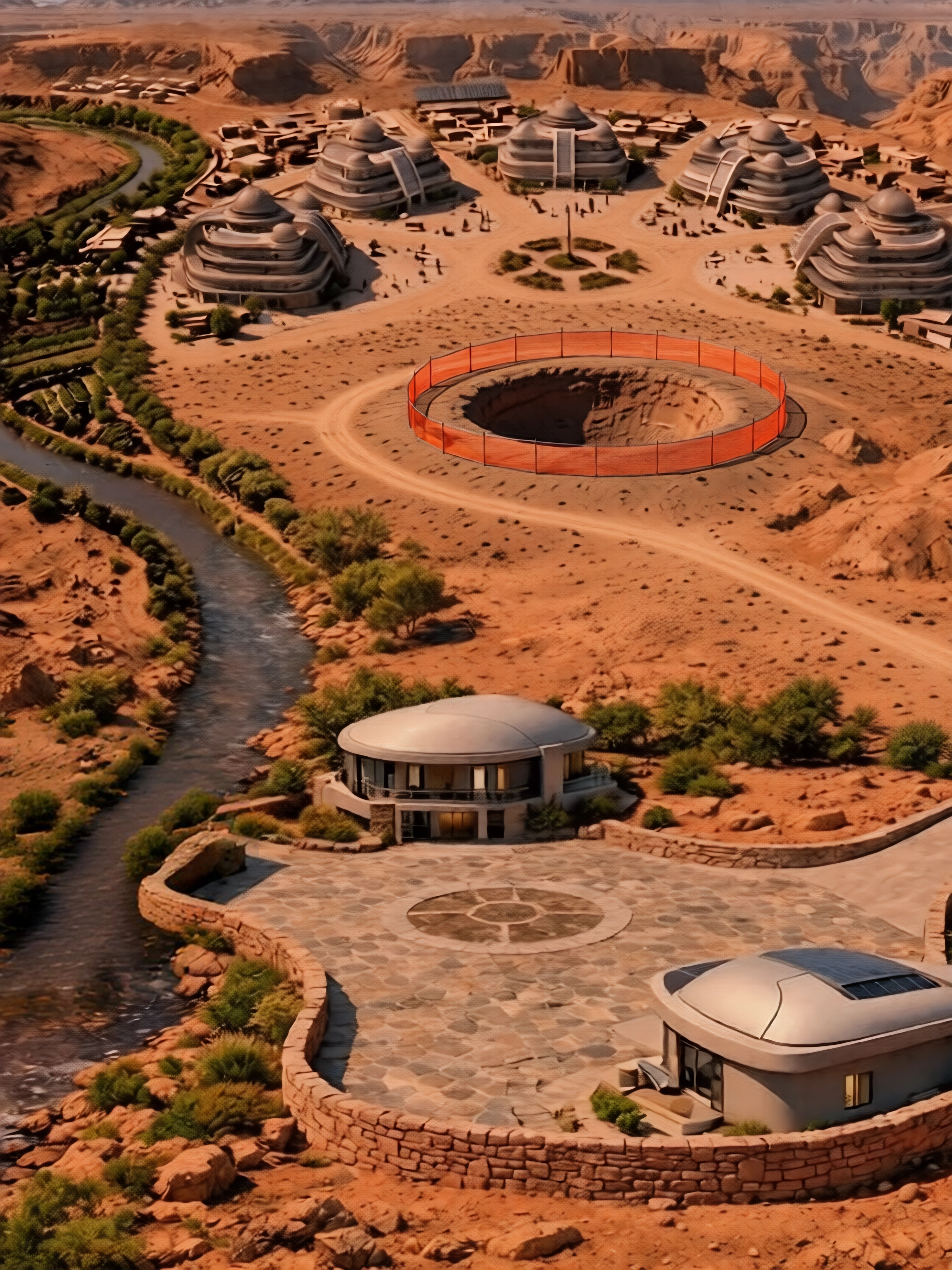
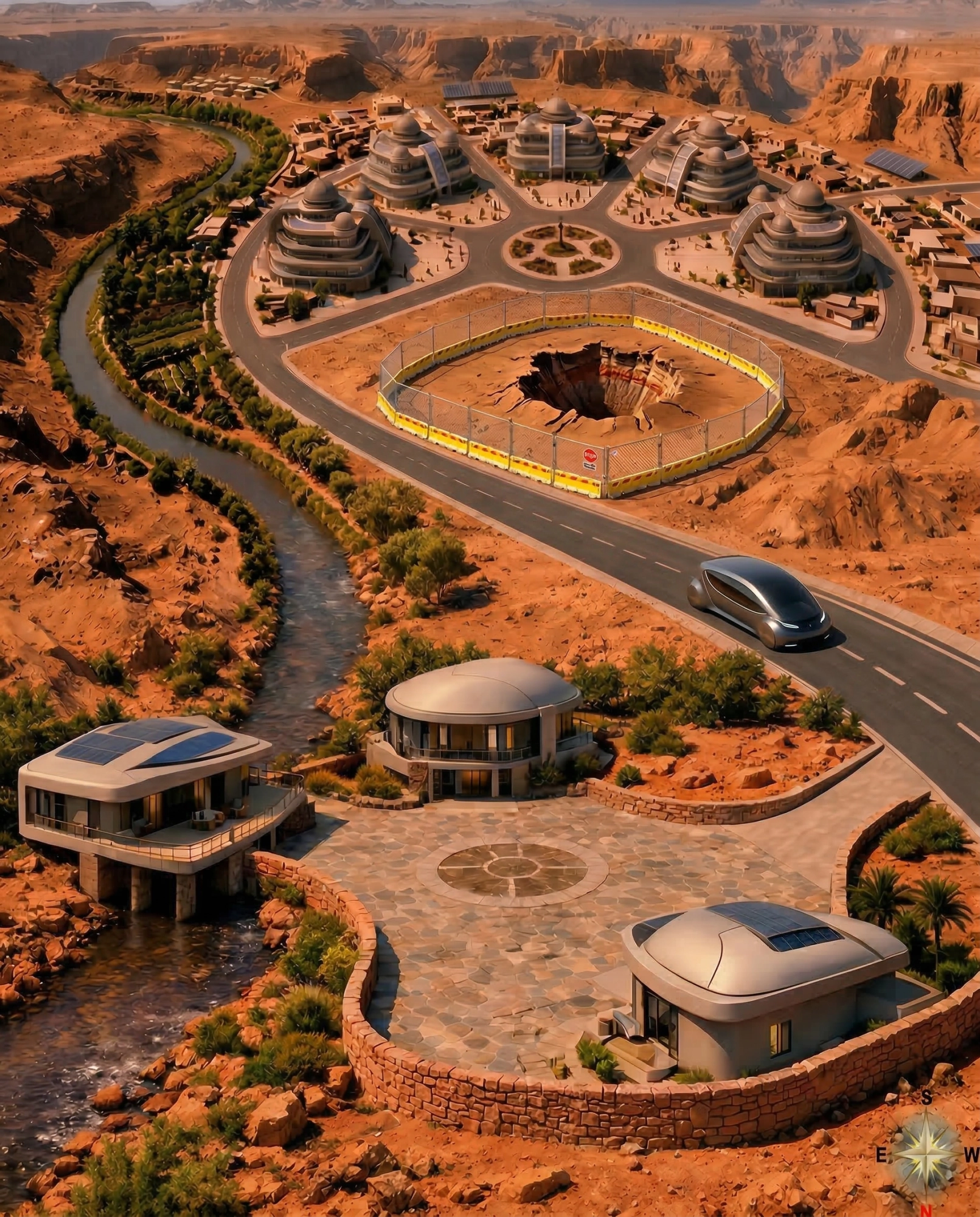
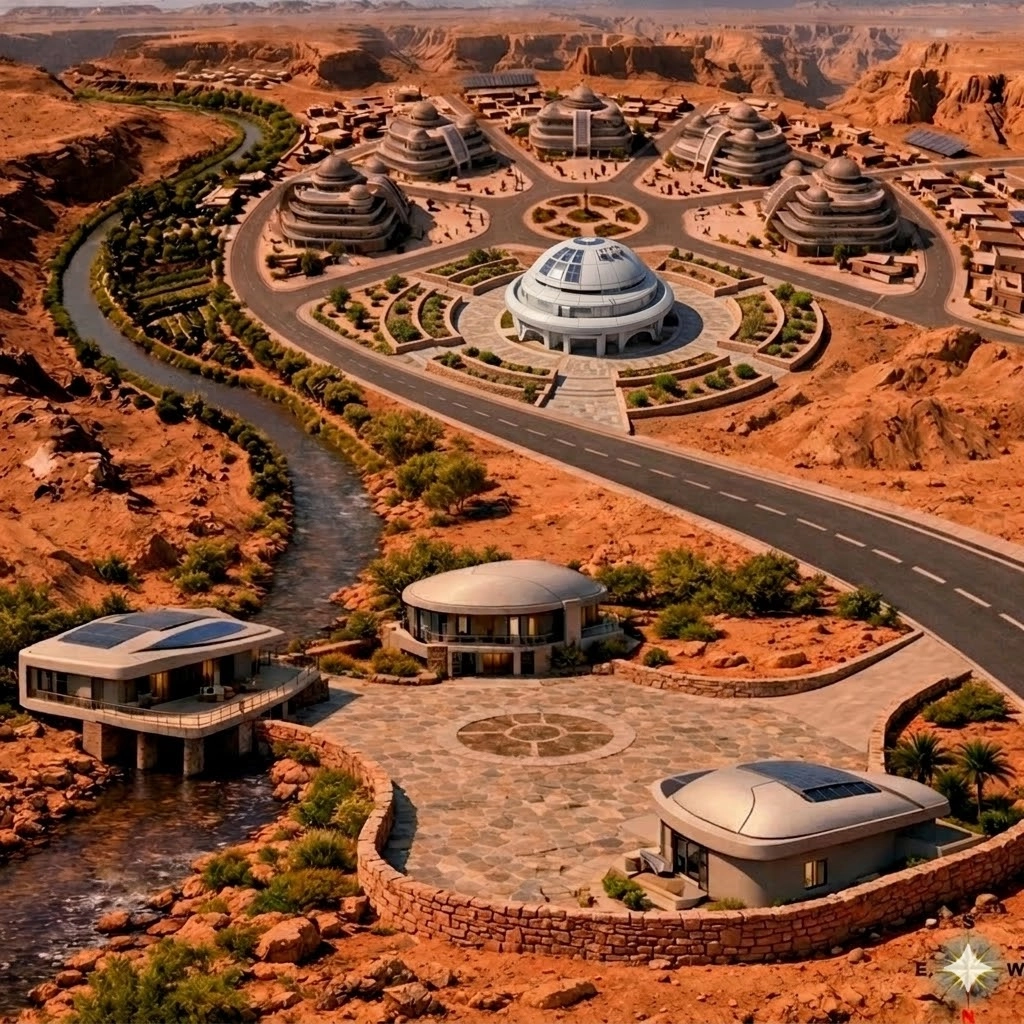
The village is a blend of old and new: modular colony units from the original Utopis ship are nestled between newer dwellings of stone, steel, and glass. These structures cluster around a central roundabout, forming a tight-knit community. A fusion reactor sits west of the settlement, its containment dome visible from nearly every rooftop—a gleaming white sphere on the rust-red plain.
Key residential developments: The Bowers home—residence of Celectra Carisco-Bowers, Jaxon Bowers, and their family—was completed between Books 2 and 3, replacing earlier temporary housing. Its construction marked the family's permanent commitment to surface life.
The fenced crater: For Books 1-4, a fenced depression on the roundabout's sixth side marked the future site of the Samaya Gallery. Children played near its edges, and colonists would picnic on the grass berm, speculating about what would one day stand there.
Central Roundabout
At the heart of New Eden, six buildings stand in a perfect ring around the colony's central roundabout. Five of these—the Medical Center, Science and Technology Center, Activity Center, Plenum, and The Nexus—are identical in their external architecture, constructed during the colony's founding. A sixth, the Samaya Gallery and Museum of Integration, was added between Books 4 and 5, completing the hexagon.
The roundabout itself features a kinetic fountain, radial pathways, Utara information kiosks, and a time capsule buried beneath the fountain to be opened in 100 years. It is the de facto meeting point for all colonists: "Meet me at the roundabout."
📍 Central Hub 🏛️ Six Buildings ⛲ Kinetic Fountain
For complete details on each building, see New Eden's Central Buildings.
Government
New Eden is governed by a democratic technocracy – leadership is vested in experts and department heads whose authority derives from proven competence. The colony’s legislative and judicial functions are centered in the Plenum, one of the six buildings ringing the central roundabout. Its circular Council Chamber houses twelve voting council members (heads-of critical sectors) and one non‑voting ambassador, who together debate policy, allocate resources, and hold tribunals when necessary.
All sessions are open to colonists, and decisions are informed by Utara, the colony AI, which projects long‑term outcomes before any vote. For complete details on the council, its members, and notable tribunals, see The Plenum and Council Chamber.
⚖️ Technocracy 🏛️ Open Sessions 🤖 Utara Projections
Surroundings
New Eden is nestled in a crook of the Pison River, which runs north to south through the southern hemisphere. The settlement hugs the river's bend, with plans to eventually bridge its waters as expansion continues. On the eastern edge, the river glitters like a ribbon of melted glass, its narrow green banks stitched with genetically modified flora—trees and shrubs engineered to survive the planet's arid conditions. Beyond the river stretch rust-red plains, cracked and dry, shimmering in the heat. To the west, the fusion reactor's containment dome rises like a geometric moon fallen to ground, visible from nearly every rooftop.
New Eden Observatory
Perched on a ridge southeast of the settlement, within easy walking distance of the town center, the New Eden Observatory is a sleek, modest dome dedicated not to serious research—that happens aboard space vessels—but to educational tours and the simple wonder of stargazing. Its glass panels gleam under the binary sunset, reflecting the golden light of Niamh and the deepening pink of Ciara. The path to the dome winds through red-dust trails and scattered rocks, offering a panoramic view of the village below.
💫 "It's less about serious astronomy—there are space vessels for that—and more about educational tours and viewing the warm super-Jupiter, Chaos, that Ares and other moons orbit."
Inside, a circular observation platform sits beneath a transparent roof, offering an unobstructed view of the sky. From this vantage point, visitors can witness the synchronized descent of Niamh and Ciara, followed by the rise of Chaos—a copper-hued gas giant whose swirling reds and blacks resemble a cosmic storm, orbited by its family of moons: volcanic Hermes, crystalline Athena, ancient Poseidon, adaptive Demeter, and Ares itself.
A Memorable Evening
The observatory is also the setting for a quiet character moment in the series. Amerigo Carisco walks up to the dome with Dr. Zoë Carisco on an evening picnic date—a rare respite from their responsibilities. As they watch the stars emerge over the rust-red plain, Zoë's communicator chimes. It's Celectra's babysitter: the child is having a nightmare, trauma-induced because of Kret. The romantic evening becomes a tender reminder of their shared duty, and they hurry back down the ridge together, hand in hand, to comfort their daughter.
The observatory remains a place of both public education and private memory—where colonists learn about the Niamh–Ciara system and where a family once ran home through the dusk.
For complete details on the Observatory, see New Eden Observatory.
🔭 Educational Tours 🌌 Viewing Chaos 🧺 Picnic Spot 🌙 Ares' Sky
Cultural Notes
New Eden is often described as both too small and too crowded—a paradox born of its intimate scale and the weight of expectation. For many colonists, it represents survival, legacy, and the beginning of a new chapter. Children like Celectra grow up surrounded by the remnants of interstellar travel and the slow emergence of planetary life, watching the settlement evolve from puzzle-piece modules into a living village.
The completion of the Samaya Gallery in Book 5 marked a turning point—the colony finally had a space dedicated not to survival, but to expression. The fenced crater that children had played around for years was now a museum, and New Eden felt, for the first time, like a permanent home rather than a temporary outpost.
Settlement Timeline
| Period | Development |
|---|---|
| Pre-Series | Original five buildings constructed; dirt roads; fusion reactor operational; observatory built |
| Book 1 | Dirt roads throughout; fenced crater where Gallery will stand; no Bowers home yet |
| Between Books 1 & 3 | Roads paved; Bowers home constructed for Amerigo, Zoë, and Celectra |
| Book 3 | Paved roads complete; Bowers home occupied; crater remains fenced |
| Between Books 4 & 5 | Samaya Gallery constructed on crater site, completing the hexagon |
| Book 5 | Full hexagon complete; labeled maps created for visitors |
→ Full Guide: New Eden's Central Buildings ←