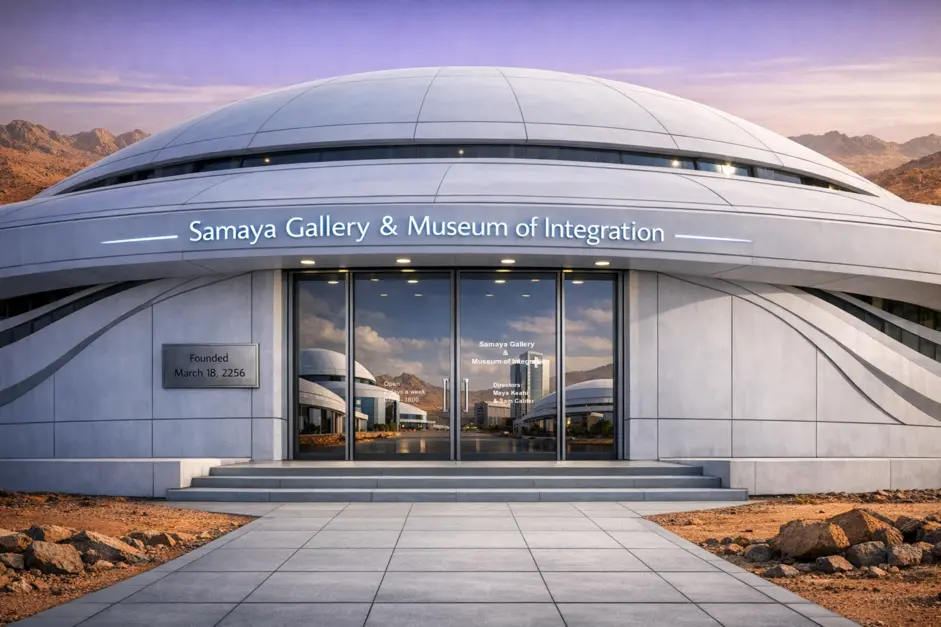
The Gallery as seen from the central roundabout
|
|
| Type | Art Museum / Cultural Center / Archive |
|---|---|
| Location | New Eden Town Center (sixth-building) |
| Construction | Between Books 4 & 5 |
| Co-Directors | Maya Keahi (visual-arts) • Sam Calder (sound) |
| Key Theme | Human-Galinstanian Integration |
| Notable Feature | Meteor Crater Basement (archives) |
| Affiliation | Dr. Celectra Carisco-Bowers (historical-consultant) |
Overview
The Samaya Gallery and Museum of Integration stands as the sixth and final building around New Eden’s central roundabout, constructed between Books 4 and 5 of the series. Named after the colony’s first dedicated artist, it serves a dual purpose: a fine art gallery celebrating human creativity, and a museum documenting the profound integration between human colonists and the indigenous Galinstanians — a process in which Dr. Celectra Carisco-Bowers played an integral role.
Unlike the original five buildings with their identical exteriors, the Gallery was designed to harmonize with its predecessors while expressing its unique cultural mission. Its completion transformed the central hexagon from purely functional to fully human, adding art to the colony’s circle of health, knowledge, activity, governance, and community.
🎨 Visual Arts 🔊 Sound Sculpture 🜁 Integration Archive 🌌 Crater Vault 🤝 Co-Directed
Founding & Leadership
The Gallery’s creation was driven by two visionary artists whose partnership — both personal and professional — shaped its identity. Before the Gallery existed, they made art anywhere they could find space.
Maya Keahi
Co-Director & Primary Visual Artist
she/her
A painter, sculptor, and installation artist whose work explores the intersection of human emotion and alien experience. In Books 2-4 , Maya became known throughout New Eden for organizing exhibitions in unlikely spaces — primarily the Activity Center, where she transformed empty dojos, spare dance studios, and even yoga rooms into temporary galleries. These “guerrilla exhibitions” built public demand for a permanent cultural space.
“A dojo at dawn, with mats rolled up and light slanting through the windows — that’s a gallery. It always was. We just needed the walls to remember it.” — Maya
Sam Calder
Co-Director & Sound Sculptor
they/them
A composer and sound artist who joined the colony in Book 3. Sam works with field recordings, bio-acoustic translation, and immersive audio environments. They arrived just as Maya’s exhibition movement was gaining momentum, and the two formed an immediate creative bond — and later, a personal partnership. Sam’s sound installations now permeate the Gallery, creating layered experiences where visual art and audio are inseparable.
“Maya gives the Integration something to see. I give it something to hear. Together, we give it a voice.” — Sam
The Pre-Gallery Years (books-2-4)
Before the Samaya Gallery existed, Maya Keahi was already bringing art to New Eden — she simply had to be creative about venues. The Activity Center became her unofficial gallery space:
- Empty Dojos: The martial arts spaces, unused during off-hours, hosted Maya’s first major solo exhibition: “Bodies Like Ours,” exploring human form through Galinstanian-influenced perspectives.
- Dance Studios: With their mirrored walls and sprung floors, these became immersive installation spaces — Sam Calder’s first collaborative piece with Maya was staged in one such studio in late Book 3.
- Acrobatics & Yoga Rooms: Their high ceilings and neutral walls proved perfect for large-scale works and meditative exhibitions.
- Gymnasiums: The largest exhibitions, including the annual Colony Art Showcase, took over main gym floors during holiday closures.
These temporary spaces built a cultural momentum that made the Gallery’s construction inevitable. When the colony voted to fund a permanent museum, Maya and Sam were the natural choices to lead it — together.
The Integration Collection
At the heart of the Gallery’s mission is the documentation and celebration of Human-Galinstanian Integration — the complex, beautiful, and sometimes challenging process of two species learning to coexist. Much of the museum’s collection directly addresses this theme, and much of what is preserved exists because of one woman’s work.
Dr. Celectra Carisco-Bowers — xenobiologist, diplomat, and the human most intimately involved in early Galinstanian contact — donated her personal archives, research notes, and correspondence to the museum. Her role in the Integration was integral : she was present for first contact, helped establish communication protocols, and became the Galinstanians’ most trusted human. The museum’s Celectra Wing houses this material, ensuring the Integration is never forgotten or mythologized incorrectly.
The Integration theme appears across media:
- Visual Art: Maya’s “Dialogue Series” paints human and Galinstanian figures in shared spaces, their forms blurring and influencing one another.
- Sound Installations: Sam’s “Frequency of Meeting” translates Galinstanian subvocal patterns into human-audible soundscapes.
- Historical Artifacts: Physical objects from early contact — translation devices, gift exchanges, the original integration agreements.
- Oral Histories: Recorded interviews with human and Galinstanian participants in the Integration, available in the Listening Grove.
The Crater Vault: Archives & Storage
🌠
Built in a meteor crater
The Gallery’s basement level was constructed within a small, ancient meteor crater — a natural depression that became the perfect climate-stable environment for archival storage.
When excavation began for the Gallery, workers discovered a small but well-preserved meteor crater beneath the building site. Rather than fill it, the architects designed the basement to incorporate it — creating a naturally cool, seismically stable environment ideal for preserving delicate artifacts. The crater’s walls were lined with climate-control systems, but its natural thermal mass reduces energy consumption by 40% compared to surface storage.
Levels of the Vault
- Upper Basement (crater-rim): Temporary storage, receiving area, conservation labs where artifacts are prepared for exhibition.
- Mid-Level (crater-walls): Rolling art racks for paintings, sculpture storage, and crated exhibitions awaiting rotation.
- Deep Vault (crater-floor): The most sensitive materials — Dr. Carisco-Bowers’ original notes, fragile Galinstanian artifacts, and the museum’s permanent collection not on display. Climate is held at strict 18°C, 45% humidity.
- The Core: At the very bottom, a small glass-walled viewing area allows researchers to see the original impact strata — a reminder of the deep time that predates human arrival.
Contents
- Dr. Celectra Carisco-Bowers Archive: Personal journals, first-contact records, Galinstanian vocabulary notes, and the original translation algorithm prototypes.
- Galinstanian Cultural Artifacts: Objects gifted during the Integration process, preserved with consultation from Galinstanian cultural advisors.
- Human Colony Archive: Secondary copies of important colony documents, artworks awaiting restoration, and the master recordings of Sam Calder’s sound installations.
- The “Pre-Gallery” Collection: Works from Maya’s Activity Center exhibitions, now preserved as part of the colony’s cultural history.
Gallery Levels
| Level | Name | Function |
|---|---|---|
| B | Crater Vault | Archives, storage, conservation (see-above) |
| 1 | Samaya Wing | Permanent collection: the colony’s first artist, original works |
| 2 | Integration Hall | The story of human-Galinstanian coexistence, Dr. Carisco-Bowers’ legacy |
| 3 | Earth Legacy Wing | Digital recreations of humanity’s greatest artworks (solid-light-projection) |
| 4 | Contemporary & Rotating Exhibitions | Living artists, including Maya & Sam’s current work |
| R | Roof Terrace & Performance Space | Sculpture garden, intimate concerts, view of the roundabout |
Featured Spaces
🎨 Samaya Wing
The colony’s first artist, Samaya, worked in relative obscurity during the early years. This permanent collection preserves her paintings, sketches, and the only known example of her sculptural work. The wing ends with a window overlooking the crater — connecting the artist to the deep time beneath.
🜁 Integration Hall
The heart of the museum. A chronological journey through first contact, the difficult early years, and the gradual emergence of trust. Dr. Carisco-Bowers’ original journals are displayed here (with-digital copies in the crater vault for researchers).
🌍 Earth Legacy Wing
Using Solid-Light projection technology (similar-to the nexus’s tactile archive), this wing presents high-fidelity recreations of humanity’s greatest artworks — from Lascaux to Kahlo, from the Buddhas of Bamiyan to Basquiat. Visitors can “handle” some pieces without damaging originals that exist only in digital memory.
🔊 The Calder Listening Grove
A permanent installation by Sam Calder: a circular room filled with hidden speakers playing a constantly evolving composition based on Galinstanian vocalizations, human heartbeats, and the resonant frequencies of the crater itself. Benches carved from native stone invite lingering.
🖼️ Maya Keahi Gallery
One full wall of Level 4 is dedicated to Maya’s ongoing work. The space is reconfigured for each new series — she considers the gallery itself part of the artwork.
👥 Children’s Integration Studio
Where young colonists (and-young galinstanians, when present) create art together. The walls are covered in a rotating mural that changes weekly.
The Celectra Archive
Dr. Celectra Carisco-Bowers’ relationship with the Gallery goes beyond donation — she serves as Honorary Curator of Integration History and consults on all exhibitions related to first contact and Galinstanian culture. Her ongoing involvement ensures the museum’s portrayal of the Integration remains accurate and respectful.
“Celectra didn’t just witness the Integration — shemade it possible. The Gallery exists to make sure no one forgets that. Every time a child touches a Solid-Light version of a Galinstanian gift-object, they’re touching her legacy too.” — Maya Keahi
Highlights of the Archive include:
- Translation Journals: Her daily logs from the first six months of contact, showing the painstaking process of building communication.
- Gifted Objects: Items given to Celectra personally by Galinstanian elders, never before displayed publicly, now in a special case in Integration Hall.
- Holographic Interviews: Recorded conversations where Celectra reflects on the Integration, available for researchers in the Crater Vault.
Cultural Significance
The Samaya Gallery represents New Eden’s cultural coming-of-age. Its construction between Books 4 and 5 marks a turning point in the series — from a colony focused on survival and efficiency toward one that values expression, reflection, and the preservation of memory.
In the Novels
- Books 2-4: Maya’s guerilla exhibitions in the Activity Center appear in several scenes, building the case for a permanent gallery. Her frustration with packing and unpacking art in borrowed spaces becomes a running theme.
- Book 3: Sam Calder arrives, and their first collaboration with Maya (a-sound-and-light installation in a dance studio) becomes a pivotal moment in both their artistic and personal relationship.
- Between Books 4 & 5: The Gallery’s construction is a major subplot — debates over funding, design, and whether art is “essential” to colony life.
- Book 5 onward: The Gallery features prominently as a setting for key scenes: Integration ceremonies, diplomatic visits from Galinstanianans, and quiet moments of reflection for characters processing the colony’s history.
Maya & Sam’s Partnership
Their relationship — creative and personal — is woven into the Gallery’s identity. Visitors often find them working together in the fourth-floor contemporary space: Maya at an easel, Sam surrounded by recording equipment, their art growing in dialogue. The Gallery is not just their workplace; it’s their shared artwork, constantly evolving.
At a Glance
| Aspect | Detail |
|---|---|
| Named For | Founders and directors Maya Keahi and Sam Calder |
| Founded | Between Books 4 & 5 in 2256 |
| Co-Directors | Maya Keahi (she/her) • Sam Calder (they/them) |
| Key Theme | Human-Galinstanian Integration |
| Integral Consultant | Dr. Celectra Carisco-Bowers |
| Notable Feature | Meteor Crater Basement Archive |
| Predecessor | Activity Center exhibitions (books-2-4) |
| Technical Highlight | Solid-Light projection in Earth Legacy Wing |