Ares
|
|
| Ares | |
|---|---|
| Parent body | Chaos (super-jupiter) |
| Day length | 18 hours (non-synchronous) |
| Orbital period | 45 days |
| Star system | Niamh-Ciara binary system |
| Distance from barycenter | 1.2 AU |
| Diameter | ~11,200 km (near-earth-sized) |
| Gravity | 0.9 G |
| Atmosphere | 0.8 Atm (breathable) |
| Human settlement | New Eden (pison-river) |
Contents
Overview
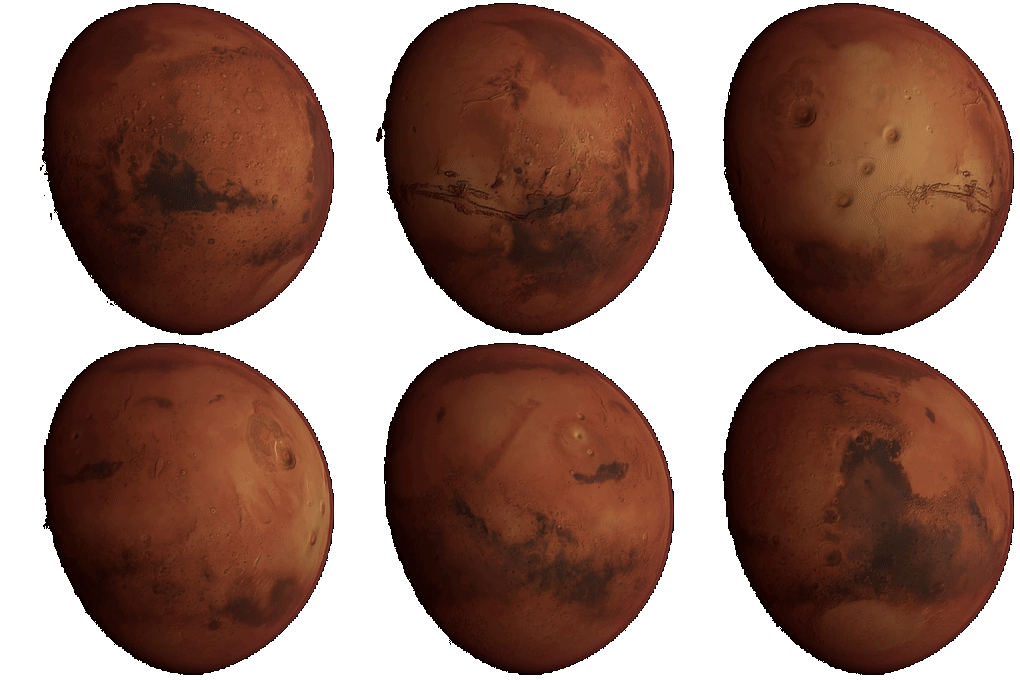
Ares is the outermost, near-Earth-sized moon orbiting the super-Jupiter Chaos in the Niamh-Ciara binary system. Captured approximately 2–5 million years ago—a recent event in cosmic terms—Ares has not yet become tidally locked to its parent planet. It features a reddish, iron-oxide-rich surface and a breathable 0.8 Atm atmosphere. Its 18-hour day and 0.9 G gravity are driven by a large, fast-spinning core, making it a dynamic world supporting the New Eden colony.
Physical Characteristics
Ares has a diameter of approximately 11,200 kilometers. Unlike older moons in the system, its 18-hour rotation is independent of its 45-day orbital period, though this rotation is gradually slowing due to tidal braking from Chaos. Its surface is marked by four small rivers—Pison, Gihon, Hiddekel, and Euphrates—fed by subsurface aquifers.
Atmosphere and Climate
Ares’ atmosphere measures 0.8 atmospheres, comprising 18-20% oxygen, nitrogen as the dominant gas, and traces of carbon dioxide. This thin air is breathable with adaptation—newcomers may require oxygen support, while native-born children develop enhanced lung capacity. The climate features pale, fractured dawns refracted through Chaos’s storms, with temperatures ranging from -20°C to 26°C, moderated by stellar heat, tidal forces, and internal geothermal activity. Eclipses from the binary stars add dynamic insolation challenges.
Geology and Interior
Ares’ geology reflects its captured origin, with a basaltic crust and iron-rich regolith. Its standout feature is a large, fast-spinning core, likely molten and metal-rich, generating a strong magnetic field to shield the atmosphere. This core drives the 18-hour day and geothermal heat, sustaining warm caverns with bismuth veins that amplify signals. The rivers originate from aquifers fed by this internal warmth, shaping the moon’s sparse but vital hydrology.
Orbit and System
Ares resides in a mildly elliptical orbit as the outermost of Chaos’s five moons: Hermes, Athena, Poseidon, Demeter, and Ares. Because Ares orbits further out than its siblings, the inner moons often appear clustered near Chaos in the Aresian sky. The system follows a P-type orbit around the binary stars Niamh (g-type) and Ciara (k-type), which are separated by only ~0.15 AU. Other planets in the system include Oisín, Ra, Odin, Vishnu, Quetzalcoatl, and Amaterasu.
Native Life
Ares was initially deemed sterile, lacking native carbon-based life. However, the discovery of the Galinstanians—sentient, metal-based beings inhabiting subsurface caverns—challenged this view. These creatures, detailed in the Galinstanian article, use bismuth veins for telepathic communication, thriving in the moon’s geothermal environment. No other native life forms have been identified.
Human Colonization
New Eden, a small colony of about 200 souls along the Pison River, represents humanity’s foothold on Ares. Established to study the moon and its resources, the settlement features stone, steel, and glass houses around a council hall, with old modules integrated into the layout. The 0.8 Atm atmosphere requires adaptation—children born here develop larger lungs, while adults use oxygen enrichment. Utopis, a geostationary space station, supports logistics and research.
Cultural Significance
Ares derives its name from its Martian-like terrain, a testament to its reddish, iron-oxide-rich landscape. The moon’s cultural importance stems from its role as a frontier of human resilience, with genetically altered trees and plants—adapted to extreme temperature fluctuations and the lack of traditional seasons—supporting New Eden’s ecosystem. The discovery of the Galinstanians reshapes narratives of exploration, highlighting the moon’s unique geothermal caverns and rivers as symbols of adaptability.