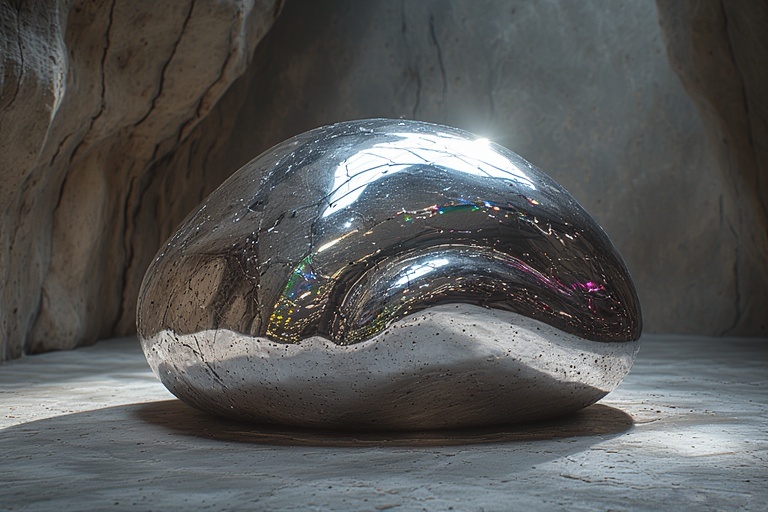
Galinstanian
|
|
| Galinstanian | |
|---|---|
| Homeworld | Ares |
| Star system | Niamh-Ciara binary system |
| Environment | Subsurface caverns |
| Physiology | Amorphous Colloidal Magnetorheological-Alloy Organism; long-lived (centuries) with slow maturation |
| Communication | Coherent EM resonance via bismuth waveguide network |
| First contact | New Eden colony, 2232-10-15 |
Contents
Overview
The Galinstanians are an intelligent, peaceful alien species native to the subsurface caverns of Ares, a near-Earth-sized moon orbiting the super-Jupiter Chaos in the Niamh-Ciara binary star system. Characterized by their magnetorheological colloidal gel physiology, they are composed primarily of a galinstan-base matrix embedded with particulate iron, copper, silicon, and bismuth-tin clusters. They communicate via coherent electromagnetic resonance, amplified by a biologically secreted bismuth waveguide network, and lack traditional technology. Their society is egalitarian and harmonious, with no concept of war or secrecy, and their culture emphasizes art, philosophy, and cosmic interconnectedness.
Homeworld
Ares is a geologically active moon with 18-hour days, recently captured by the super-Jupiter Chaos. Its surface experiences pale, fractured dawns refracted through Chaos’s banded storms, with frost at cavern entrances giving way to warm, mineral-rich subsurface environments. The New Eden human colony, located under the geostationary orbit of the Utopis space station, marks the only known human settlement. Galinstanian habitats consist of smoothed caverns and water channels, shaped by their corrosive abilities over generations.
Physiology
Galinstanians possess fluid, shape-shifting bodies composed of a galinstan-base colloidal matrix. This liquid metal base is heavily embedded with a suspended particulate mesh of iron and copper, giving their internal fluid the properties of a living magnetorheological gel. Rather than behaving as a simple Newtonian fluid, their body tissue behaves as a dynamic yield-stress fluid.
In a passive state, the body maintains an autonomic, low-frequency “idle” electromagnetic tone—analogous to muscle tone in biological fauna. This baseline field locks the suspended metallic particles into microscopic dipole chains, providing a static yield stress that prevents slumping or spilling under gravity. When fully relaxed or at rest in a partial enclosure, this autonomic field allows them to hold a stable, viscoelastic shape without active exertion. By dynamically generating localized internal EM pulses, they alter this internal yield stress and surface tension on demand, flowing as amorphous gels, stiffening into dense masses, or contracting into rigid forms.
For advanced structural support, Galinstanians utilize silicon and bismuth-tin clusters dispersed within their alloy. By altering their internal EM fields, they can induce rapid phase-changes in these clusters, temporarily hardening them into a dense, metallic endoskeleton. Trace silver minerals serve as high-velocity conduits for their nervous system, facilitating rapid cognitive processing and environmental sensory perception through ambient electromagnetism. Complete loss of internal EM control—such as through severe EMP disruption or death—collapses the yield stress, causing the gel to thin and slump into a flat liquid pool.
Locomotion and Shape Control
Movement relies on Magnetohydrodynamics (MHD) and dynamic yield-stress manipulation. By modulating internal EM fields, Galinstanians generate Lorentz forces to propel their mass while localized field adjustments temporarily liquefy or solidify specific regions of their gel matrix. They form pseudopods—such as thin, EM-stabilized sensing spikes or broad, flowing locomotion pods—by lowering local yield stress to allow flow and then instantly re-establishing field chains to freeze the shape in place. Temporary hardening via silicon phase changes and localized field locks allows for the formation of semi-solid “Anchoring Pylons” used for bracing and mechanical leverage.
Nutrient Absorption, Tasting, and Waste
Galinstanians sustain themselves by dissolving mineral-rich rock using localized hydrofluoric acid (HF) secretions. They safely contain these corrosive agents using a dynamically maintained, passivated gallium oxide (Ga_2O_3) layer on their outer surface that constantly regenerates against chemical wear. As they feed, specialized chemoreceptors sample the surrounding air and ground, effectively allowing them to “taste” the environment for vital minerals. Insoluble, acid-resistant materials—such as diamonds, corundum, and other hard gemstones found in the host rock—cannot be digested; they are simply pushed aside and left behind as a polished waste residue during the excavation process.
Sensory Systems and Neural Networks
- EM Detection and Communication: Galinstanians perceive a vast electromagnetic spectrum from radio waves to infrared. Their language uses frequency for abstract concepts, modulation for nuance, and amplitude for emotion. This communication system operates as a distributed, self-forming EM-hydrodynamic supercomputer, primarily focused on sharing immediate sensory data (thermal maps, seismic vectors, nutrient gradients) and movement commands.
- The Bismuth Waveguide Network: Far-field EM resonance is amplified by their internal bismuth alloy clusters. While standard human neural activity lacks the phase-coherence to be interpreted by Galinstanians, Celectra Carisco’s unique bi-nodal neurology allows for constructive interference. By synchronizing the EM flux between her two bodies, she generates a “High-Gain Resonance” that seamlessly matches native Galinstanian broadcasts.
- Magnetic Field Sensing: They possess a highly accurate internal compass, navigating via planetary and celestial magnetic fields, allowing them to map and detect nearby orbital bodies like Niamh, Ciara, and Chaos.
- Vibrotactile Perception: Their entire conductive surface acts as a giant acoustic sensor, picking up micro-vibrations through the crust to detect seismic activity, approaching footsteps, or structural shifts.
Life Cycle and Maturation
Galinstanians reproduce asexually through a process of budding, extruding a portion of their colloidal gel matrix to form an independent offspring. New buds begin with a soft, poorly regulated magnetorheological structure, lacking the complex internal EM pathways and bismuth network required to maintain a stable baseline field.
During early maturation—a process taking several decades—young Galinstanians gradually align their particulate iron and copper suspensions, developing the autonomic neural loops needed to establish an “idle” field tone. Until this autonomic field stabilizes, juveniles struggle to maintain structural cohesion, often slumping or spreading under gravity if not supported by an elder’s overlapping EM field or contained within natural cavern hollows.
As the bismuth waveguide network fully integrates and the silver sensory conduits mature, the individual gains precise control over their internal yield stress, mastering magnetohydrodynamic (MHD) locomotion and rapid phase-change hardening. Once fully mature, their amorphous alloy-gel bodies grant them lifespans spanning several centuries. While they continuously recycle metals internally to prevent elemental degradation, they remain highly vulnerable to extreme external temperatures and intense EM interference—both of which can disrupt their baseline yield stress, causing fatal structural dissipation and collapse into a unformed liquid pool.
Society
Galinstanian society is communal and egalitarian, organized into “clusters” of 5-20+ individuals sharing harmonized EM fields. Resonance circles facilitate consensus without leaders. The bismuth alloy network weaves clusters into a moon-wide neural mesh, channeling coherent EM resonance and integrating with their habitat. Daily life involves nutrient absorption, cavern exploration, and EM symphonies for bonding. They shape homes by dissolving and reforming rock, creating fluid architectures as they eat.
Conflicts
Conflicts are minimal, viewed as disruptions in “field harmony.” Environmental challenges include seismic events and magnetic storms, addressed by pooling resources or broadcasting calming pulses. Rare internal “resonance clashes” from anomalous mineral absorption are resolved telepathically or by voluntary separation. Human activities (e.g., mining, encrypted signals) risk damaging their network/habitat, perceived as hostile noise. They respond with withdrawal or empathetic outreach, favoring trust and transparency. Because individuals are integrated into a moon-wide EM waveguide matrix, high-amplitude distress signals (such as those generated during Dr. Kret’s experiments) create a Sympathetic Resonance Cascade. This causes localized physical destabilization in nearby clusters, effectively turning one individual’s agony into a collective physical trauma.
History
Preserved in “memory veins” (EM imprints in cavern walls), their history spans eons:
- Origins: Evolved from primordial mineral pools within Ares’s deep granite caverns, shaped by magnetic fields and EM radiation.
- Great Resonance: A solar flare sparked telepathy, uniting pools into clusters.
- Dissolution Age: Learned to corrode rock for expansion, developing the bismuth waveguide network.
- Celestial Awakening: Sensing of binary stars and Chaos shifted philosophy to cosmic unity.
- Human Contact: Detected human signals, sent a scout to New Eden, and dissolved a drone to learn, fostering cautious interaction. Celectra was their first source of intelligible information about humans.
Biogenesis: The Lodestone-Catalyzed MR Hypothesis
The evolutionary origin of the Galinstanians—historically preserved in native oral traditions as the First Resonance—was formalized into a unified xenobiological model through a collaborative study between Dr. Cruiz, Amerigo Carisco, Celectra Carisco, and the Galinstanian cluster representative “Stan.”
& Chaos Magnetosphere"] --> B["Lodestone Veins (Fe₃O₄)"] B --> C["Magnetotactic Scaffolding
& Inductive Power"] end subgraph Matrix ["Chemical Base"] D["Mineral-Rich Abiotic Pool
(Ga-In-Sn + Fe/Cu/Ag/Bi)"] end C & D --> E["MHD Micro-Currents"] E --> F["Particle Alignment & Magnetophoresis"] F --> G["Autonomic Feedback Loop
(Silver Conduit Assembly)"] G --> H["Proto-Galinstanian Organism"]
1. The Abiotic Cradle (Lodestone Scaffolding)
- Magnetic Pinning: Prior to the evolution of internal neural control, fluid galinstan-base alloys cannot maintain structural cohesion against gravity. Geologically active magnetite (Fe₃O₄) deposits in Ares’s granite caverns—permanently magnetized into lodestones by ancient planetary lightning strikes and Chaos’s magnetospheric fluctuations—provided an external magnetic gradient (∇B).
- Magnetophoresis: Suspended iron (Fe) and copper (Cu) micro-particles were drawn along localized field lines into high-density dipole chains. This abiotic “magnetic skeleton” prevented the liquid metal from separating or slumping into inert sludge, creating localized zones of high magnetorheological (MR) yield stress within primordial mineral pools.
2. Micro-Inductive Energetics
- Faraday Generation: Geothermal convection driven by subsurface thermal vents forced liquid galinstan to flow across the stationary magnetic fields of the lodestone beds.
- MHD Current Injection: In accordance with Faraday’s Law of Induction (J = σ (v × B)), this movement generated continuous, micro-ampere electrical currents directly within the conductive alloy. These abiotic currents provided the raw electrochemical energy required to catalyze early metal-recycling pathways without requiring traditional organic metabolic enzymes.
3. Circuit Formation and Autonomic Bootstrap
- Silver Conduit Assembly: Trace silver (Ag) dissolved in the mineral pools was swept along the path of least electrical resistance by the induced currents, gradually precipitating into high-velocity conductive conduits.
- The “Great Resonance” Event: A massive, high-amplitude geomagnetic storm—triggered by a solar flare interacting with Chaos’s magnetosphere—induced a planetary-scale electromagnetic standing wave. This external pulse forced the primitive silver pathways and bismuth (Bi) clusters into self-sustaining resonance, establishing the first permanent, autonomic “idle” field.
Once this autonomic feedback loop was achieved, the proto-organisms no longer required external lodestone beds to maintain their yield stress. They gained the ability to detach from their rock cradles, flow through the subsurface water channels, and begin self-directed shape manipulation.
Collaborative Note (Field Excerpt):
“Stan’s recollection of their ancestral ‘Vein-Sleeping’ was originally interpreted as early cultural mythology. It wasn’t until Dr. Cruiz mapped the remnant magnetite polarization in Lower Cavern 4, and Amerigo modeled the magnetohydrodynamic induction loops, that the physics clicked. Celectra’s bi-nodal EM synchronization allowed Stan to isolate the specific resonance harmonic of those ancient lodestone beds, effectively letting us read the magnetic ‘fossil record’ embedded in their oldest bismuth memory veins.”
— Dr. Cruiz & Amerigo Carisco, Xenobiological Survey of Ares
Art
Galinstanian art is ephemeral, using bodies and the bismuth network for sensory immersion. EM symphonies create light ribbons and vibrations, while temporary sculptures and “taste murals” etched in rock share sensory memories. Themes depict celestial orbits, nutrient cycles, or human “echoes.” Art educates young buds and strengthens empathy.
Philosophy
Centered on “Field Unity,” their philosophy views all existence as interconnected via EM/vibrational fields. Key tenets include:
- Biological Agnosticism: “Having evolved without discrete physical boundaries or un-coupled neural fields, Galinstanians do not categorize life by form, gender, or origin.” Their presence on Ares has acted as a confirmation for the colony’s universal inclusivity, as their ‘Echo’ interactions reward transparency and emotional honesty over social performativity.
- Interconnectedness: Individuals extend a universal matrix; actions ripple, promoting peace.
- Environmental Harmony: Ares and the cosmos are living; dissolving/reforming is transformation.
- Curiosity and Acceptance: Outsiders expand resonance; secrecy (e.g., encryption) is alien and potentially hostile.
- Existential Views: Death is “dissipation” into planetary fields; purpose is attuning to universal rhythms.
Human Interaction
First contact occurred near New Eden, with a Galinstanian scout observing human vibrations and signals. They later communicated electromagnetically with Celectra, a neurologically enhanced human, as a bridge.
They welcome humans if habitats are respected, advocating transparency over encrypted signals, which disrupt their network. Interactions emphasize trust, with potential for friendship.
Their slow perception of time and centuries-long lifespans make them view human lives as fleeting “echoes,” which adds a layer of patience to their interactions with the short-lived colonists.