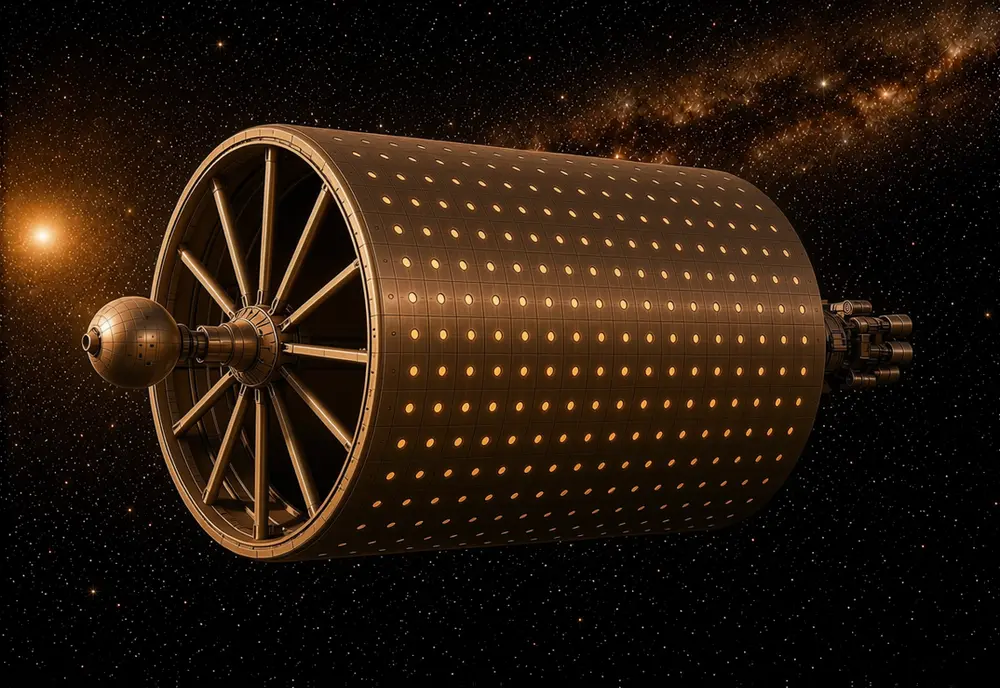
Utopis Space Station
|
|
| Type | Interstellar spaceship / Orbital space station |
|---|---|
| Operator | New Eden Colony, overseen by AI Utara |
| Launched | October 9, 2125, 02:40 PM CDT (fictional-launch) |
| Destination | Ares moon, 45 light-years from Earth |
| Journey Duration | ~79 years proper time, ~90 years objective time |
| Maximum Speed | 0.5c |
| Diameter | ~403 meters |
| Rotation Rate | 2 RPM (post-arrival-as station) |
| Artificial Gravity | 0.9 -g centrifugal (post-arrival); 0.9 -g propulsion during journey |
| Habitat Levels | 3 stories |
| Original Population | 100 colonists |
| Current Population | ~195 (including-95 offspring) |
| Orbit | Geostationary at an Altitude of 25,265 km above New Eden, Ares equator |
| Detached Components | Utopis-Labs 1–3 (mobile-research platforms) |
| AI System | Utara (sentient-central computer) |
Utopis is an interstellar spaceship and subsequent orbital space station. Launched on October 9, 2125, at 02:40 PM EDT, it transported 300 colonists 45 light-years to the moon Ares, establishing the colony town of New Eden near the equator. Controlled by the sentient AI Utara, the ship completed its journey under continuous 0.9 -g propulsion, with colonists in cryosleep for ~78.53 years (proper-time) or ~90 years (objective-time) and awakening post-arrival in 2215. The core cylinder now operates as the Utopis space station in geostationary orbit 25,265 km above New Eden, while three detached habitat rings became mobile research platforms, Utopis-Labs 1–3. “Seventeen years post-arrival, the colony’s population is distributed across Utopis, three mobile research labs, and New Eden. Despite its expansion, the community remains tight-knit, with a total population of ~800, including offspring like Celectra.”
Overview
The Utopis was designed for a ~78.53-year journey (proper-time) to Ares, accelerating to 0.5c over 216 days, maintaining constant velocity for ~77.345 years, and decelerating over 216 days, all under 0.9 -g propulsion. Colonists relied on cryosleep within gyroscopic hammock-suspended pods to endure the trip, awakening in orbit for a 1-year rehabilitation period. The station now supports a growing population, oversees the surface colony, and facilitates research, with a fully equipped hydroponics bay for immediate use.
Design and Structure
The Utopis features a cylindrical habitat module with an external shell diameter of approximately 403 meters. It rotates at 2 RPM post-arrival to generate 0.9 -g centrifugal gravity, though during the journey, 0.9 -g propulsion provided gravity, negating the need for rotation.
Habitat Cylinder
- Levels : The cylinder is 3 stories thick radially, with floors parallel to the curved outer wall.
- Portholes : Floor-mounted portholes on the outer level offer downward views. Mid-level residents lack views unless at the ends, while upper-level ceiling portholes show the core.
- Core and Spokes : The core rotates with the cylinder, connected by large spokes with elevators for radial movement.
- Cryo-Pods : Gyroscopic hammock-suspended pods facilitated cryosleep during the journey. Post-arrival, they were repurposed as hydroponics containers on Ares’ surface, supporting New Eden’s agriculture.
- Hydroponics Bay : A fully equipped bay within the cylinder sustains the station’s population and provides seeds/equipment for surface hydroponics.
Additional Components
- Zero-G Gym : A spherical module at the front end with a 40-meter interior diameter, used for microgravity training and recreation.
- Engine and Power : A rear block houses engines and a fusion reactor, providing 0.9g propulsion and power.
Journey and Operations
The Utopis maintained 0.9g throughout its ∼78.53-year journey. During the 216-day acceleration and deceleration burns, 0.9g was provided by the engine thrust itself. During the ∼77-year coasting phase, 0.9g was provided by centrifugal force from the ship’s rotation. Throughout all phases, Electrical Muscle Stimulation (ems) supplemented the mechanical loading to ensure health. At the midpoint of the coasting phase, the ship performed a 180-degree yaw maneuver (“flip”) to orient its main engine toward the destination. Rotation was then stopped before the 216-day deceleration burn began, allowing the pods to align with the 0.9 -g axial force for the braking burn. Upon arrival, colonists awoke in orbit for a 1-year rehabilitation period in 0.9g after rotation resumed. The AI Utara managed navigation, life support, and separation of the Utopis-Labs.
Post-Arrival Configuration
Utopis Space Station
In geostationary orbit above New Eden, Utopis houses ~195 residents, including 95 children in sprawling suites. It supports a tight-knit community with a hydroponics bay for food production and oversight of the surface colony, guided by Utara.
Utopis-Labs 1–3
Three ~400-meter-diameter, ~150-meter-long habitat rings detached as mobile research platforms, exploring Ares’ solar system. Each maintains 0.9 -g at 2 RPM and conducts specialized research, with independent propulsion.
Colony Integration
Seventeen years post-arrival, New Eden thrives as a tight-knit colony near Ares’ equator, utilizing repurposed cryo-pods for hydroponics. Utopis’ geostationary orbit ensures constant communication and support, with Utara coordinating colony-station interactions.
Cultural and Technological Notes
Utara : The sentient AI oversees Utopis’ systems, evolving into a companion for colonists.
Hydroponics Development : Repurposed cryo-pods, originally for cryosleep, now serve as hydroponics containers, symbolizing the colony’s self-sufficiency. Utopis’ bay provides initial resources.