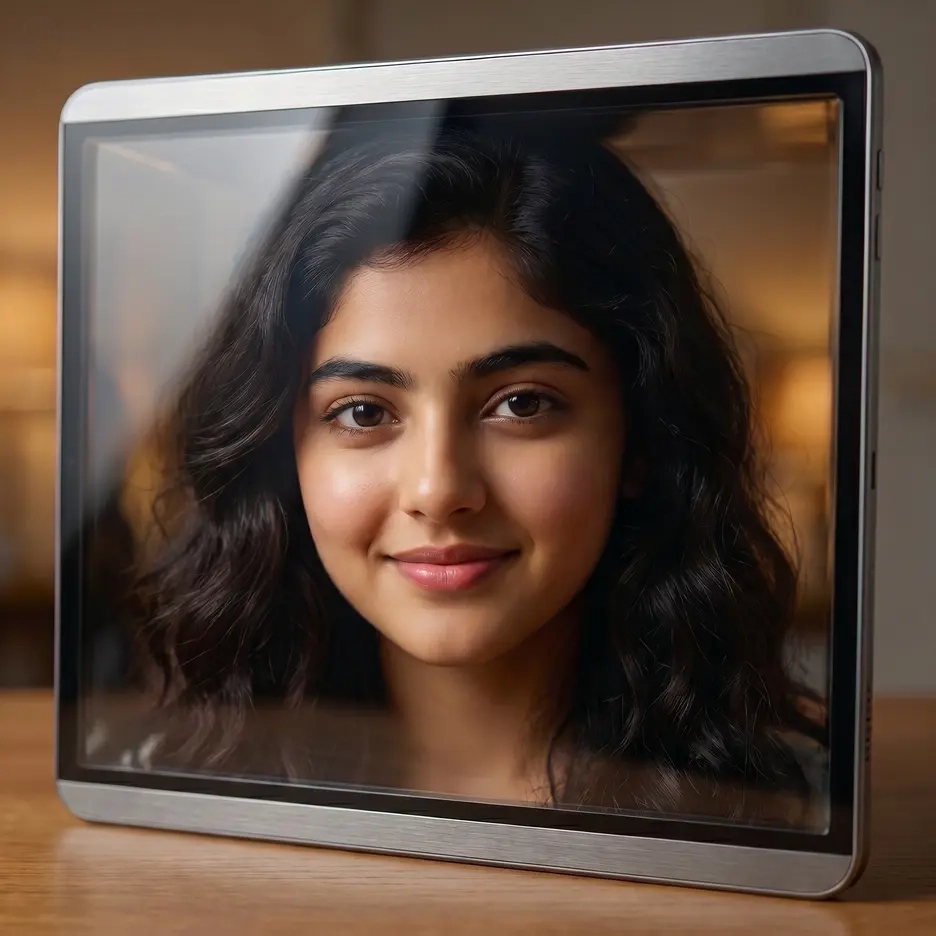
Holopad / Holoscreen Series-7 in Active (transparent) mode
|
|
| System Specifications | |
|---|---|
| System Designation | Holopad / Holoscreen Series-7 |
| Core Architecture | Transparent Autostereoscopic Light-Field Display (ALFD) |
| Substrate | Aluminosilicate glass + GaAs micro-emitters |
| Bezel Material | High-density carbon composite |
| Display Modes | Active (Transparent) / Shade (High-Contrast) |
| Depth Tracking | Multi-camera parallax, real-time IPD mapping |
| Self-Cleaning | Oleophobic coating + Ultrasonic (22 kHz) |
| Input Methods | Virtual Keyboard (haptic) / Resonant Stylus |
System Designation: Holopad / Holoscreen Series-7
Core Architecture: Transparent Autostereoscopic Light-Field Display (ALFD)
1. PHYSICAL FORM FACTORS & OPTICS
- Substrate: Chemically strengthened aluminosilicate glass matrix with embedded gallium-arsenide micro-emitters.
- Opaque Perimeter Bezel: High-density carbon composite housing containing the logic board, solid-state battery array, eye-tracking sensors, and peripheral emitters.
- Depth Mechanics: Multi-camera parallax tracking maps the user’s precise interpupillary distance (IPD) in real-time. The active light-field display steers distinct photon vectors to each eye, generating internal perceived depth (the “Shadowbox Illusion”) without external projecting mediums.
2. OPACITY & CONTRAST MANAGEMENT
- Layer Composition: Integrated Polymer-Dispersed Liquid Crystal (PDLC) layer sandwiched between the active light-field matrices.
- Active Mode (Default/Transparent): Zero voltage application keeps liquid crystals in a scattered state, allowing ambient light to pass through with 92% optical clarity.
- Shade Mode (High-Contrast): Micro-voltage alignment shifts the PDLC layer into a highly dense, light-absorbing matte black backing.
- Operational Nuance: Crucial for reading text or viewing complex 3D renders against bright environments. Automatically pairs with spectacles and building windows for station-wide circadian shifting (“Night Shift for Dayshift”).
3. CONTAMINATION MITIGATION (SELF-CLEANING)
- Passive Layer: Permanent fluoropolymer matrix molecularly bonded to the outer glass. This ultra-durable oleophobic coating prevents skin lipids and moisture from adhering or smearing, forcing them to bead loosely on the surface.
- Active Layer (Sonic Shiver): Frame-mounted piezoelectric actuators that emit high-frequency ultrasonic waves (22 kHz) across the glass panel during standby or manual cycles.
- Operational Nuance: The micro-vibration instantly breaks the weak surface tension of the beaded lipids and pocket dust, atomizing or shearing the debris off the lower bezel edge. Emits a low, audible acoustic pulse (150 Hz) to violently pump out liquid if completely submerged.
4. USER INTERACTION & INPUT SYSTEMS
- Virtual Keyboard (VK): Projected haptic-aligned light arrays on the glass surface. Uses localized, low-amplitude acoustic surface waves to provide a micro-pulse of resistance against fingertips, simulating tactile key registration.
- Resonant Stylus: Passive electromagnetic resonance (EMR) or active digital pen utilizing a fine-point tungsten-carbide tip.
- Operational Nuance: The stylus syncs with the screen’s internal depth layer, allowing users to “sink” the tip past the physical glass plane to manipulate 3D spatial models, draft vector blueprints, or sign encrypted logs inside the light-field volume.