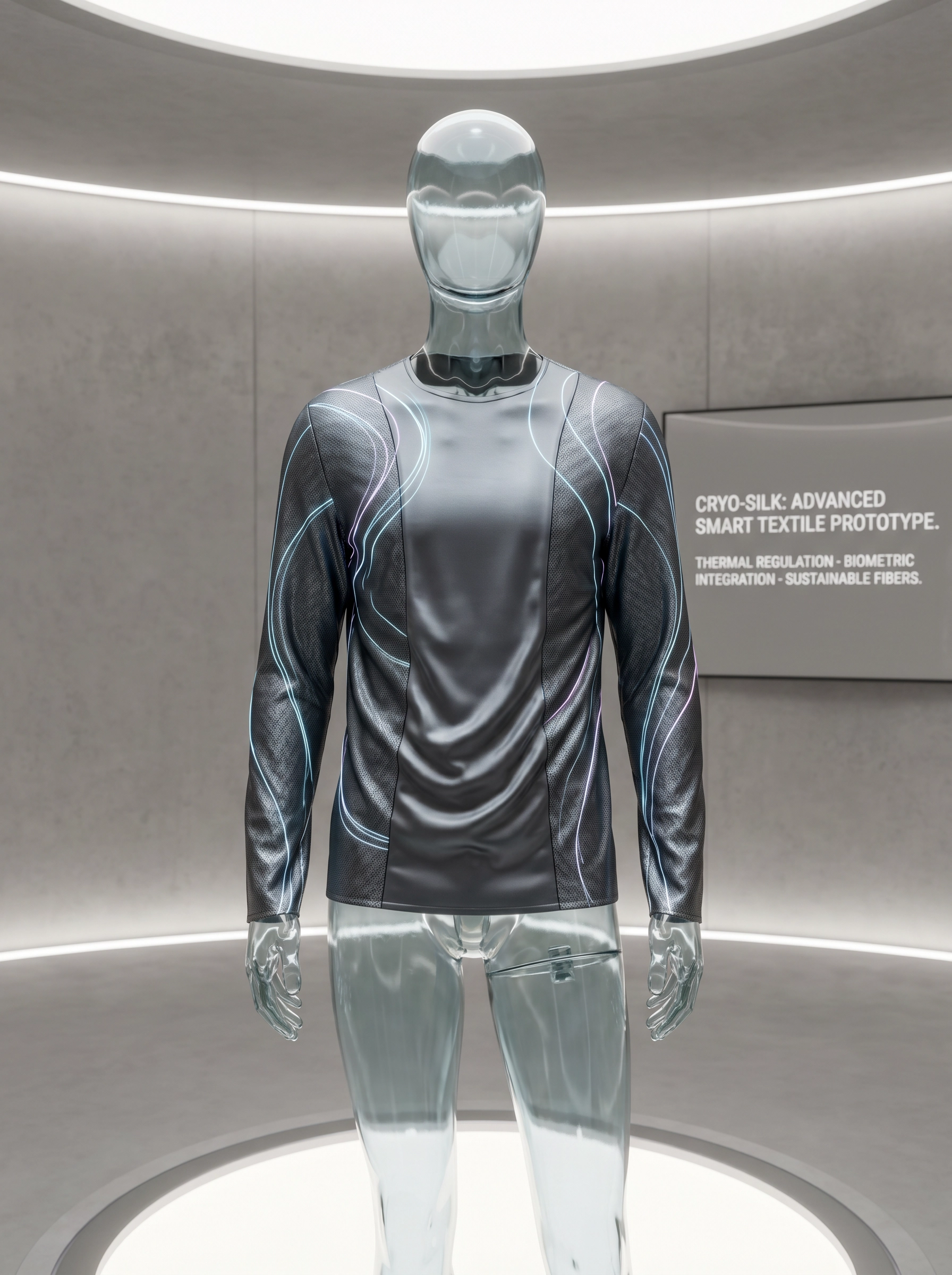
Cryo-silk garmet on a mannequin
|
|
| Material Specifications | |
|---|---|
| Origin | Medical emergency development (Celectra neonatal case); decentralized open-source synthesis |
| Primary Composition | Graphene-infused high-denier lyocell; beechwood MicroModal dermal layer; passive polymer optical fiber matrix |
| Core Function | Thermoregulating, dermatologically protective, bacteriostatic smart textile with passive phototherapeutic luminance matrix |
Material Profile: Cryo-Silk
Classification: Advanced Biocarbon-Cellulosic Hybrid Textile
Primary Composition: Graphene-infused high-denier lyocell, micro-gauge fine beechwood MicroModal, integrated passive polymer optical fiber (pof) matrix.
Cryo-silk is a non-proprietary, open-source advanced smart-apparel material. Engineered to bridge the gap between heavy industrial durability and hyper-sensitive dermatological protection, it has become the mainstream global standard for civilian and stellar attire synthesized via the Molecular Reconfiguration Engine (mre).
Origins & Discovery
Unlike corporate-designed synthetic polymers, cryo-silk was born entirely out of medical emergency. Following the birth of Celectra, who exhibited severe congenital albinism, standard MRE-synthesized fabrics quickly proved catastrophic to the infant’s highly delicate skin. Within her first week of life, standard synthetic blends caused persistent, severe diaper rashes and friction-induced systemic fevers that conventional medical protocols failed to soothe.
Faced with an urgent medical crisis, Dr. Alex Cruiz collaborated with his best friend and Celectra’s father, master materials scientist Amerigo Carisco. Working directly at the atomic level, Amerigo bypassed standard MRE textile algorithms to construct a radical new material framework. Within a week of Celectra’s birth, the duo successfully synthesized the first cryo-silk diapers, followed forty-eight hours later by optimized crib sheets. The breakthrough instantly alleviated the infant’s epidermal inflammation and regulated her body temperature.
Technical Architecture
- The Dermal Interface (micromodal): The next-to-skin layer utilizes a fine-gauge, silky beechwood MicroModal weave. This eliminates micro-abrasions, keeping even the most hypersensitive skin from becoming raw or itchy—a chronic failure point of standard synthesized MRE clothing.
- The Structural Core (high-denier-lyocell): Extruded from heavy eucalyptus filaments, this layer provides a high-strength, tear-resistant framework that ensures excellent dimensional stability and a clean, tailored drape that resists wrinkling.
- The Thermal Circuit (atomically-infused-graphene): Infused directly into the lyocell matrix by Amerigo Carisco’s custom code, the graphene functions as a passive heat-distribution grid. It actively wicks localized body heat away from hot spots to eliminate localized chills and breaks friction-induced fevers. Furthermore, its permanent bacteriostatic nature offers non-chemical antimicrobial odor protection that never washes out.
- The Luminance Matrix (micro-fiber-optics): Woven alongside the lyocell channels, ultra-flexible polymer optical fibers leak light evenly along their lateral surfaces. Originally engineered by Dr. Cruiz as a wearable phototherapy blue-light grid to treat newborn jaundice and promote skin healing, these passive plastic fibers carry zero electrical current or heat risk to the wearer.
Mainstream Adoption and Evolution
What began as a bespoke medical solution for a single child rapidly disrupted the entire planetary and station apparel landscape. As early adapters felt the material and witnessed its performance, the limitations of older synthesized garments became glaringly obvious. The global population, tired of the stiff, itchy, or sweaty drawbacks of standard synthetic MRE outputs, began favoring cryo-silk for everyday life.
By the time Celectra reached adulthood, cryo-silk had completely decentralized into the mainstream. Because Dr. Cruiz and Amerigo Carisco published the molecular patterns openly, the material schematic is available on all public networks. Today, it is the most frequently requested material profile for domestic, workplace, and travel garments worldwide. The original therapeutic micro-fiber-optic grid has since evolved into a highly celebrated cultural design aesthetic, allowing users to customize their attire with fluid, holopad-controlled, color-shifting swirls for the night scene.